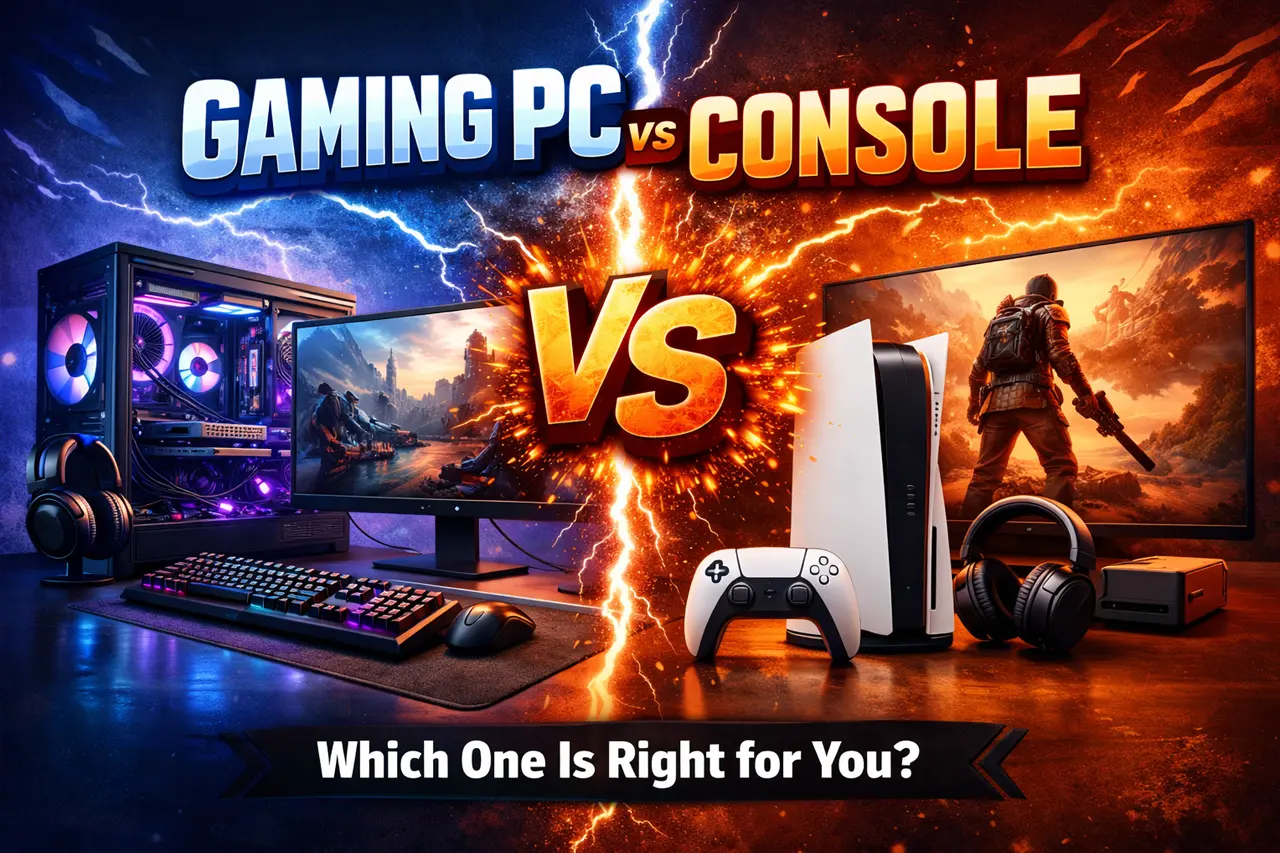
Choosing between a gaming PC and a console is one of the most common dilemmas for gamers today. Both platforms have evolved significantly, offering powerful hardware, immersive graphics, and vast gaming libraries. However, the right choice depends on how you play, what you expect from gaming, and how much flexibility you want in the long run.
In this guide, we’ll break down the real differences between gaming PCs and consoles in terms of performance, graphics, cost, flexibility, and overall experience, so you can confidently decide which platform suits you best.
Performance and Graphics: Power vs Optimization
One of the biggest advantages of a gaming PC is raw performance. Modern gaming PCs are built with powerful CPUs and GPUs that often exceed the capabilities of consoles.
Gaming PCs allow:
Higher frame rates (120 FPS, 144 FPS, and beyond)
Ultra and custom graphics settings
Support for high-refresh-rate monitors
Better performance in competitive games
Consoles, on the other hand, rely heavily on hardware optimization. Games are specifically tuned for a fixed set of components, which allows consoles to deliver impressive visuals despite lower raw power. However, they are typically limited to 30 or 60 FPS, with some newer titles supporting 120 FPS under specific conditions.
Verdict:
If you prioritize maximum performance, higher FPS, and visual control, a gaming PC clearly leads.
Graphics Customization and Visual Quality
Gaming PCs give players full control over graphical settings. You can adjust textures, shadows, ray tracing, resolution scaling, and performance-enhancing technologies like DLSS or FSR.
This flexibility allows gamers to:
Optimize performance for competitive play
Push visuals to ultra settings for cinematic experiences
Adapt to different games and hardware upgrades
Consoles offer a simplified experience. Most games provide preset modes such as Performance Mode or Quality Mode, limiting customization but making setup easier for casual players.
Verdict:
Gaming PCs win in visual freedom and customization, while consoles focus on simplicity.
Flexibility and Upgradability
A major strength of gaming PCs is upgradeability. You can replace or improve individual components over time:
Upgrade the GPU for better graphics
Add more RAM for multitasking
Increase storage capacity
Improve cooling for sustained performance
This modular approach allows your system to stay relevant for years without needing a full replacement.
Consoles, by design, are closed systems. Hardware upgrades are not possible, and users must wait for the next generation to experience significant improvements.
Verdict:
Gaming PCs offer unmatched long-term flexibility and longevity.
Cost: Upfront vs Long-Term Value
At first glance, consoles appear more affordable. Their initial price is usually lower than a gaming PC. However, the total cost over time tells a different story.
Console Costs Over Time
Paid online subscriptions
Limited hardware lifespan
Full replacement required for next generation
Gaming PC Costs Over Time
Higher upfront investment
Free online multiplayer
Incremental upgrades instead of full replacement
Multi-purpose use (gaming, work, content creation)
When spread over several years, a gaming PC often becomes a better long-term investment, especially for users who value performance and versatility.
Game Library and Platform Freedom
Gaming PCs offer access to multiple platforms:
Steam
Epic Games Store
Xbox Game Pass
Battle.net and more
This open ecosystem means more frequent discounts, free-to-play options, and access to mods that extend game longevity.
Consoles rely on exclusive ecosystems. While exclusives can be appealing, they limit flexibility and cross-platform access.
Verdict:
PC gaming provides greater freedom, variety, and value in game libraries.
Competitive Gaming and Esports
For competitive gaming, FPS and input precision matter. Gaming PCs support:
High refresh rate monitors
Lower input latency
Custom peripherals
Advanced graphics tuning
These advantages make gaming PCs the preferred platform for esports professionals and competitive players.
Consoles are more casual-friendly but generally lack the performance ceiling required for high-level competitive play.
Streaming, Content Creation, and Productivity
Gaming PCs are not just gaming machines. They are powerful workstations capable of:
Live streaming
Video editing
3D rendering
Programming and productivity tasks
Consoles are limited almost exclusively to gaming and entertainment.
If you plan to stream gameplay, create content, or work on the same system, a gaming PC is the obvious choice.
Ease of Use and Convenience
Consoles excel in simplicity:
Plug-and-play setup
Minimal configuration
Optimized gaming experience
Gaming PCs require some initial setup and maintenance, including updates and driver management. However, modern systems and pre-built gaming PCs have made this process much easier than in the past.
Who Should Choose a Gaming PC?
A gaming PC is ideal if you:
Want high FPS and ultra graphics
Play competitive or esports titles
Stream or create content
Prefer long-term upgradeability
Want a multi-purpose system
Who Should Choose a Console?
A console may be right if you:
Prefer simplicity
Play casually
Want a lower upfront cost
Enjoy exclusive titles
Final Verdict: Gaming PC or Console?
Both platforms have their place, but they serve different types of gamers.
If you want performance, freedom, and future-proof flexibility, a gaming PC is the superior choice. Consoles offer convenience, but gaming PCs deliver the ultimate gaming experience.
For gamers who want more control, better performance, and a system that grows with them, a gaming PC is the clear winner.